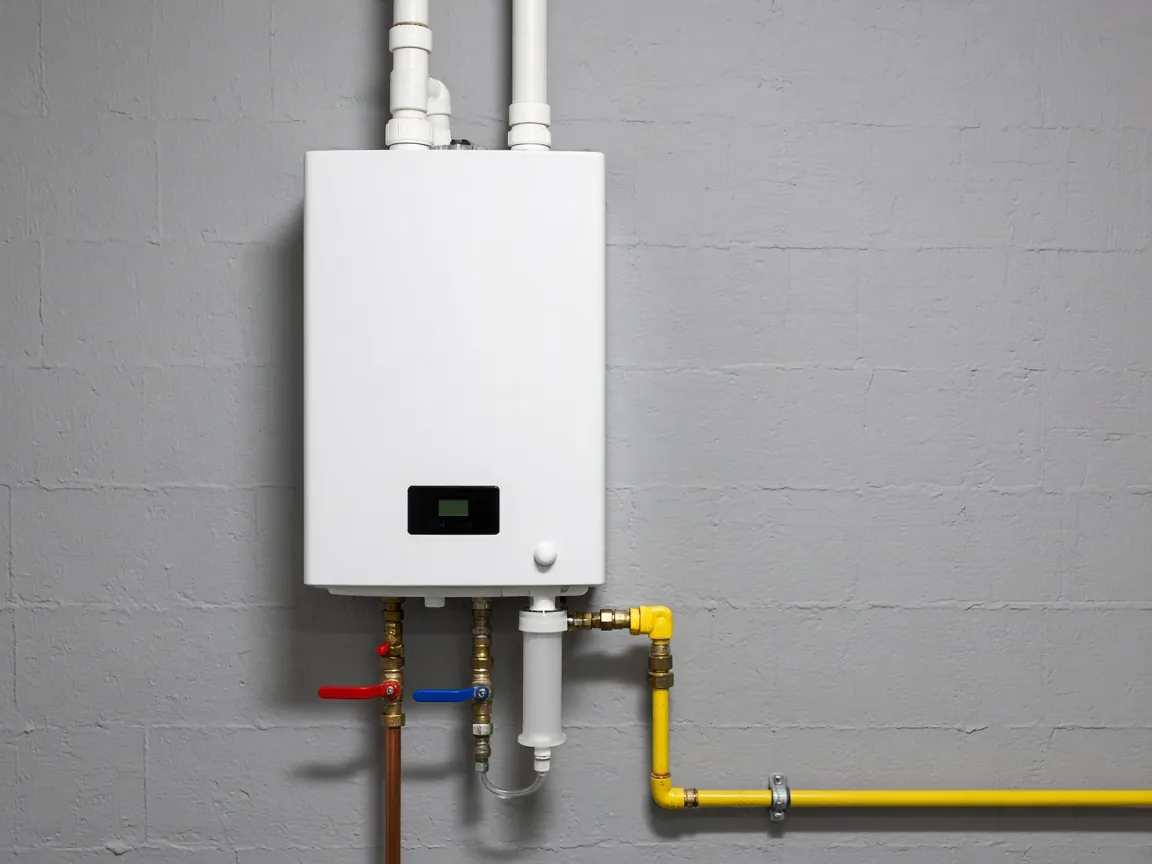
Tankless water heaters give continuous hot water and free floor space, but they cost more to install, need a larger gas supply, and must be sized for Chicago's near-freezing winter water. Tank water heaters cost less upfront, are simpler to replace, and can often reuse existing venting. The right choice depends on household size, budget, the gas line, and where a vent can go.
How they differ
A tank stores forty to seventy-five gallons and keeps it hot. A tankless unit heats water as it flows, with no storage.
Winter matters
Lake Michigan water reaches Chicago homes near freezing in deep winter. Tankless output drops as the needed temperature rise grows. Size for January, not July.
Water heater acting up? Talk it through by phone.
Call 000 000 0000Gas supply
Tankless burners use far more gas at full fire than a tank. Many Chicago bungalows and two-flats have small gas piping. Upsizing may be needed. Chicago homes are served by Peoples Gas; most suburbs by Nicor Gas.
Venting
Tanks often use the chimney. Tankless units vent through the wall. In dense Chicago neighborhoods, side walls face narrow gangways, so clearances matter.
Permits
In Chicago, switching from a tank to tankless is not an in-kind replacement. See our permit guide.
Cost and lifespan
Tankless units cost more to install but often last longer, around fifteen to twenty years versus ten to fifteen for tanks. They also need periodic descaling.
Which fits you
Tankless suits: larger households, people who run out of hot water, basements being finished, homes with adequate gas supply.
Tank suits: tighter budgets, smaller households, homes with sound chimneys and small gas lines.
Heat pump tanks: an efficient electric option for basements with space.
Next steps
See tankless water heater installation in Chicago or water heater replacement in Chicago.
Local note
A greystone near Humboldt Park and a ranch in Oak Lawn may reach different answers. House, gas, and household all matter.
Comparing costs over time
Upfront, a standard gas tank is usually the least expensive option, especially when the existing vent and gas line can be reused. Tankless costs more to buy and install, especially when gas piping must be upsized and a new vent run through the wall. Over time, tankless units use less gas for standby losses, since they do not keep a tank hot around the clock. Whether the savings repay the higher upfront cost depends on how much hot water you use and how long you stay in the home.
Space and placement
A tank takes a circle of floor space about two feet across, plus clearance. A tankless unit hangs on the wall. In a Chicago basement being finished, that freed space can matter. In a condo closet, a tankless unit may fit where a tank barely does, though venting can be harder.
Maintenance compared
Tanks benefit from yearly flushing and anode checks every few years. Tankless units need descaling every year or two on Lake Michigan water, and periodic cleaning of the inlet screen and air filter. Neither is difficult, but both need to be done.
Power outages
Many standard gas tanks with standing pilots keep making hot water without power. Tankless units, power-vent tanks, and heat pump tanks need electricity. If outages are common on your block, that may matter.
Hybrid approach
Some homes pair a small tank with a tankless unit, or use a tankless unit with a small buffer tank, to reduce the cold water sandwich and handle short draws. It adds cost but can smooth performance.
Making the call
List your household's peak hot water use, check the gas line size, look at where a vent could go, and set a budget. Those four facts usually point clearly to one option.
Recirculation and wait times
Neither a tank nor a tankless unit fixes a long wait for hot water at a distant bathroom. That wait comes from the length of pipe between the heater and the fixture. A recirculation system shortens it with either type.